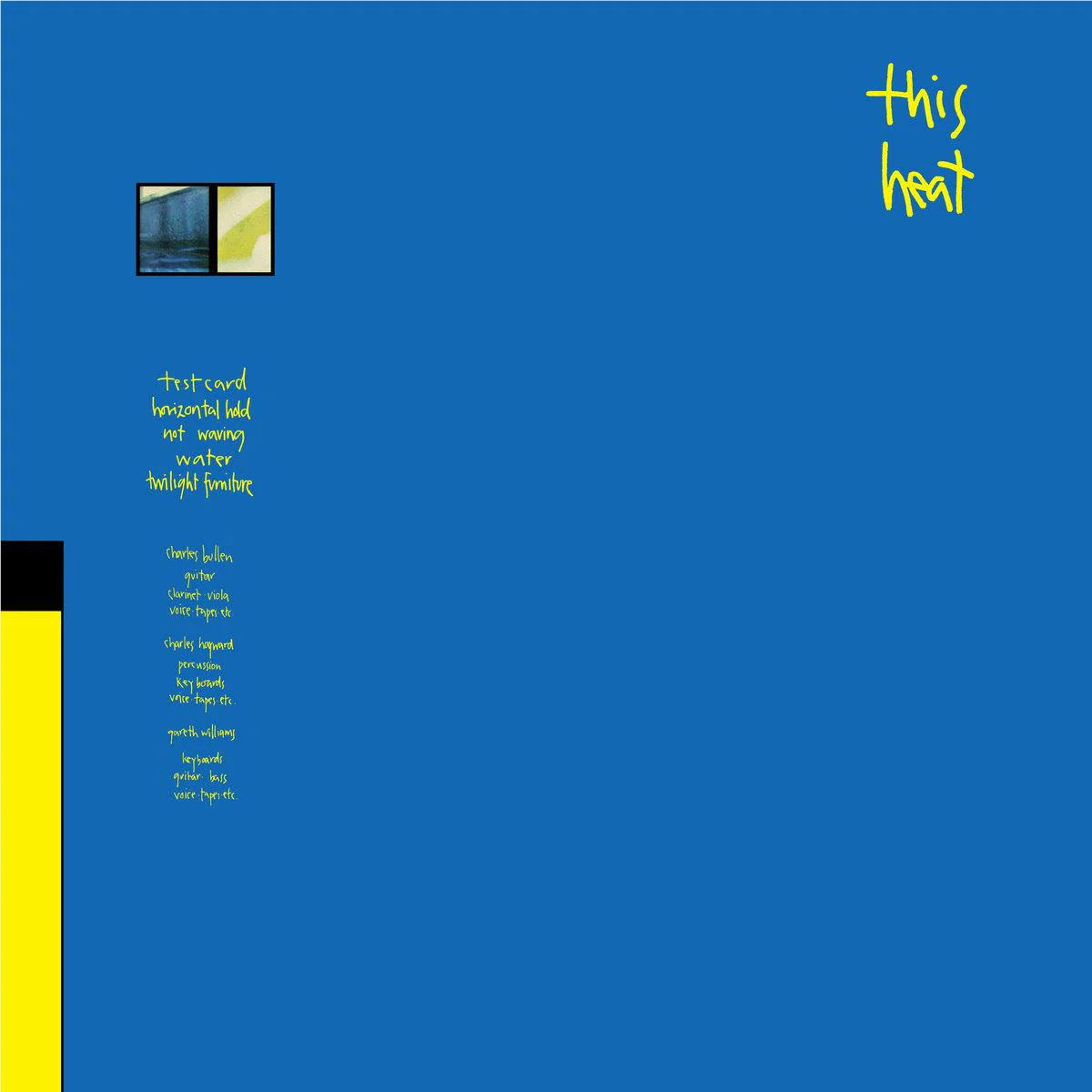
This Heat (Vinyl)
“There’s an irony inherent in the term ‘postpunk.’ Many of the groups that define the genre (think Pere Ubu or Cabaret Voltaire) existed for several years before punk. But these outfits had little hope of finding an audience until punk stirred up an appetite for the extreme, while also spawning a new breed of independent labels that could support challenging music.
“This Heat are a prime example. Formed in early 1976 by drummer Charles Hayward, guitarist Charles Bullen and ‘non-musician’ Gareth Williams, the group were initially unaware of what was brewing elsewhere in London, yet they were driven by similar impulses: to make noise expressive of the era’s turbulence. Instead of punk’s crude reduction of rock ’n’ roll, This Heat took their bearings from expansive inspirations: free jazz, Captain Beefheart, musique concrète, and reggae’s disorienting dub techniques.
“Vital to their evolution was Cold Storage, a disused meat fridge in Brixton where the band rehearsed. Produced by This Heat with David Cunningham and Anthony Moore, their 1979 debut was collaged out of cassette tapes and recordings made during ultra-cheap graveyard shifts at The Workhouse. The jump-cuts in sound quality were deliberately designed to make the album more unsettled and jarring.
“The first two principles of This Heat’s mission statement—‘All possible processes. All channels open.’—could have been co-signed by many pre-punk experimentalists. It’s the third part—‘24 hour alert.’—that makes This Heat archetypally post-punk, crystallizing the ‘totally-wired’ mood of paranoid vigilance they shared with peers like Scritti Politti and The Pop Group. Soft power—the mind-control of television and advertising—was an obsession; several tracks take their titles from the gogglebox (‘Testcard,’ ‘Horizontal Hold’). But hard power—in particular, geopolitical dominance—is also addressed in tracks like ‘The Fall of Saigon.’
“Perhaps the most startling piece here is ‘24 Track Loop.’ Breakbeat like drums are processed using the Eventide Harmonizer, a machine famously used on Bowie’s Low. The song’s creaky textures and pitch-shifted beats anticipate ‘90s jungle, but the entire album is a controlled explosion of ideas. Nearly fifty years on, This Heat’s debut is something the world has still not completely caught up with.” —Simon Reynolds
“There’s an irony inherent in the term ‘postpunk.’ Many of the groups that define the genre (think Pere Ubu or Cabaret Voltaire) existed for several years before punk. But these outfits had little hope of finding an audience until punk stirred up an appetite for the extreme, while also spawning a new breed of independent labels that could support challenging music.
“This Heat are a prime example. Formed in early 1976 by drummer Charles Hayward, guitarist Charles Bullen and ‘non-musician’ Gareth Williams, the group were initially unaware of what was brewing elsewhere in London, yet they were driven by similar impulses: to make noise expressive of the era’s turbulence. Instead of punk’s crude reduction of rock ’n’ roll, This Heat took their bearings from expansive inspirations: free jazz, Captain Beefheart, musique concrète, and reggae’s disorienting dub techniques.
“Vital to their evolution was Cold Storage, a disused meat fridge in Brixton where the band rehearsed. Produced by This Heat with David Cunningham and Anthony Moore, their 1979 debut was collaged out of cassette tapes and recordings made during ultra-cheap graveyard shifts at The Workhouse. The jump-cuts in sound quality were deliberately designed to make the album more unsettled and jarring.
“The first two principles of This Heat’s mission statement—‘All possible processes. All channels open.’—could have been co-signed by many pre-punk experimentalists. It’s the third part—‘24 hour alert.’—that makes This Heat archetypally post-punk, crystallizing the ‘totally-wired’ mood of paranoid vigilance they shared with peers like Scritti Politti and The Pop Group. Soft power—the mind-control of television and advertising—was an obsession; several tracks take their titles from the gogglebox (‘Testcard,’ ‘Horizontal Hold’). But hard power—in particular, geopolitical dominance—is also addressed in tracks like ‘The Fall of Saigon.’
“Perhaps the most startling piece here is ‘24 Track Loop.’ Breakbeat like drums are processed using the Eventide Harmonizer, a machine famously used on Bowie’s Low. The song’s creaky textures and pitch-shifted beats anticipate ‘90s jungle, but the entire album is a controlled explosion of ideas. Nearly fifty years on, This Heat’s debut is something the world has still not completely caught up with.” —Simon Reynolds
Description
“There’s an irony inherent in the term ‘postpunk.’ Many of the groups that define the genre (think Pere Ubu or Cabaret Voltaire) existed for several years before punk. But these outfits had little hope of finding an audience until punk stirred up an appetite for the extreme, while also spawning a new breed of independent labels that could support challenging music.
“This Heat are a prime example. Formed in early 1976 by drummer Charles Hayward, guitarist Charles Bullen and ‘non-musician’ Gareth Williams, the group were initially unaware of what was brewing elsewhere in London, yet they were driven by similar impulses: to make noise expressive of the era’s turbulence. Instead of punk’s crude reduction of rock ’n’ roll, This Heat took their bearings from expansive inspirations: free jazz, Captain Beefheart, musique concrète, and reggae’s disorienting dub techniques.
“Vital to their evolution was Cold Storage, a disused meat fridge in Brixton where the band rehearsed. Produced by This Heat with David Cunningham and Anthony Moore, their 1979 debut was collaged out of cassette tapes and recordings made during ultra-cheap graveyard shifts at The Workhouse. The jump-cuts in sound quality were deliberately designed to make the album more unsettled and jarring.
“The first two principles of This Heat’s mission statement—‘All possible processes. All channels open.’—could have been co-signed by many pre-punk experimentalists. It’s the third part—‘24 hour alert.’—that makes This Heat archetypally post-punk, crystallizing the ‘totally-wired’ mood of paranoid vigilance they shared with peers like Scritti Politti and The Pop Group. Soft power—the mind-control of television and advertising—was an obsession; several tracks take their titles from the gogglebox (‘Testcard,’ ‘Horizontal Hold’). But hard power—in particular, geopolitical dominance—is also addressed in tracks like ‘The Fall of Saigon.’
“Perhaps the most startling piece here is ‘24 Track Loop.’ Breakbeat like drums are processed using the Eventide Harmonizer, a machine famously used on Bowie’s Low. The song’s creaky textures and pitch-shifted beats anticipate ‘90s jungle, but the entire album is a controlled explosion of ideas. Nearly fifty years on, This Heat’s debut is something the world has still not completely caught up with.” —Simon Reynolds